Maximizing fuel efficiency with industrial oil burners requires controlling the transformation of liquid fuel into usable process heat instead of just scaling up firing capacity. Efficiency depends on the proportion of useful heat transferred to the process, which is governed by atomization quality, fuel-air balancing, combustion controls, and operating conditions.
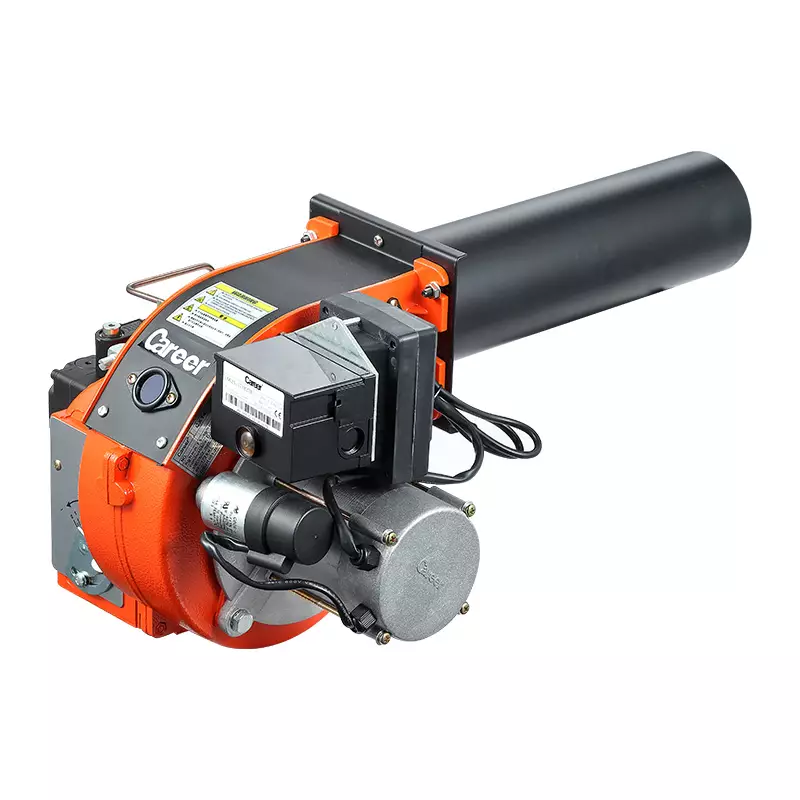
Advanced burner systems integrate these variables into a coordinated thermal solution. The CX14, a monoblock unit, combines fuel/air delivery, ignition, flame safeguards, automation, and management. Key highlights include high-pressure mechanical atomization and an integrated airflow regulator.
How Does Better Atomization Reduce Fuel Waste?
Oil must be atomized before it can burn effectively. High-pressure mechanical atomization breaks liquid fuel into smaller droplets, creating conditions for more effective interaction between fuel and combustion air. The CX14 specifically uses high-pressure mechanical atomization as part of its combustion design.
That matters because fuel preparation directly affects the combustion process. Uneven or poorly controlled fuel delivery can make flame conditions harder to maintain. Better atomization distributes the fuel more evenly, helping the burner maintain a more consistent combustion process and heat release.
Maintenance of the atomization system also matters over the operating life of a burner. The referenced model allows atomizer maintenance without removing the atomizer and uses standardized, easily sourced components. These design details can make it easier to keep the fuel-delivery side of the combustion system properly maintained.
How Does Airflow Control Improve Combustion?
Fuel efficiency also depends on how combustion air is supplied. Insufficient air can disrupt combustion, while unnecessary excess air can carry heat away through the exhaust. Efficient combustion therefore requires an appropriate relationship between the amount of fuel introduced and the air available for burning it.
The CX14 incorporates an integrated airflow regulator, placing air delivery within the burner assembly rather than treating it as an unrelated function. Modern energy efficient burners can adjust the air supply to maintain suitable combustion conditions as the heat demand changes.
Air control is particularly relevant because industrial furnaces do not necessarily experience identical conditions throughout a production cycle. Heat demand, furnace pressure, and operating requirements can change. A burner with regulated fuel and air delivery is better positioned to respond to those conditions than equipment operating without coordinated combustion control.
How Does Correct Burner Sizing Affect Fuel Consumption?
A burner cannot be considered fuel-efficient simply because it has a high maximum output. Its useful operating range must correspond to the heating equipment. Excess capacity does not automatically produce greater efficiency; what matters is supplying the heat the furnace actually requires under its operating conditions.
The CX14 is specified with an output power of 89–172 kW, heat power of 76,500–147,900 kcal/h, and oil consumption of 7.5–14.5 kg/hr. These figures describe the published range, not a guaranteed consumption level for every installation.
Furnace pressure is an explicit variable in the product documentation. The reference states that the actual fuel-consumption range depends on furnace pressure. Consequently, a high efficiency oil burner should be assessed according to the operating conditions of the connected furnace rather than by its fuel-consumption figure in isolation.
Correct sizing therefore begins with the process heat requirement. Users need to understand the required operating point, furnace conditions, and expected heat demand before deciding whether a particular burner range is appropriate.
How Can Integrated Controls Keep Combustion Efficient?
Consistent combustion requires several functions to work together. Fuel delivery, airflow, ignition, flame monitoring, and operating control each influence the combustion sequence. If these functions are coordinated within the burner, the equipment can manage the combustion process as a unified system.
The CX14 is described as fully automatic and combines ignition, flame monitoring, fuel supply, air supply, and operation management. It also provides manual fuel-flow regulation. This integrated arrangement gives operators defined functions for managing combustion instead of relying on fuel delivery alone.
Career Burner’s CX14 is also designed for industrial heating uses including food ovens, industrial boilers, hot-air generators, drying systems, and metal-processing furnaces. The relevance of the burner consequently depends on how its operating characteristics correspond with the specific heating equipment.
What Should Industrial Users Look for in a Fuel-Efficient Burner?
The most useful evaluation starts with the combustion mechanisms rather than the marketing label. Fuel preparation should be examined first: the burner needs an appropriate method for atomizing the oil. Air delivery comes next, because combustion requires controlled fuel-air conditions rather than fuel flow alone.
Output range then needs to be compared with the furnace’s actual requirements. Published figures should be treated as operating specifications, while installation conditions such as furnace pressure must also be considered. The CX14 documentation specifically identifies furnace pressure as a factor affecting actual fuel consumption.
Sustaining combustion efficiency during long-term operation requires robust control and maintenance capabilities. Consequently, implementing energy efficient burners involves a holistic engineering approach that coordinates atomization, airflow, capacity matching, automated controls, and maintenance ergonomics.
Career Burner incorporates this philosophy into the CX14 by merging high-pressure mechanical atomization, an airflow regulator, automated operation, flame supervision, and published operational limits. For industrial facilities, this multi-faceted design provides a rigorous benchmark for assessing fuel efficiency beyond simple capacity metrics.
To conclude, a high efficiency oil burner enhances fuel utilization by tightly governing fuel conditioning, air-fuel mixing, combustion progression, and heat delivery. Maximum efficiency is achieved when these combustion processes are precisely matched to furnace conditions, operating as an integrated component of the total heating system.
