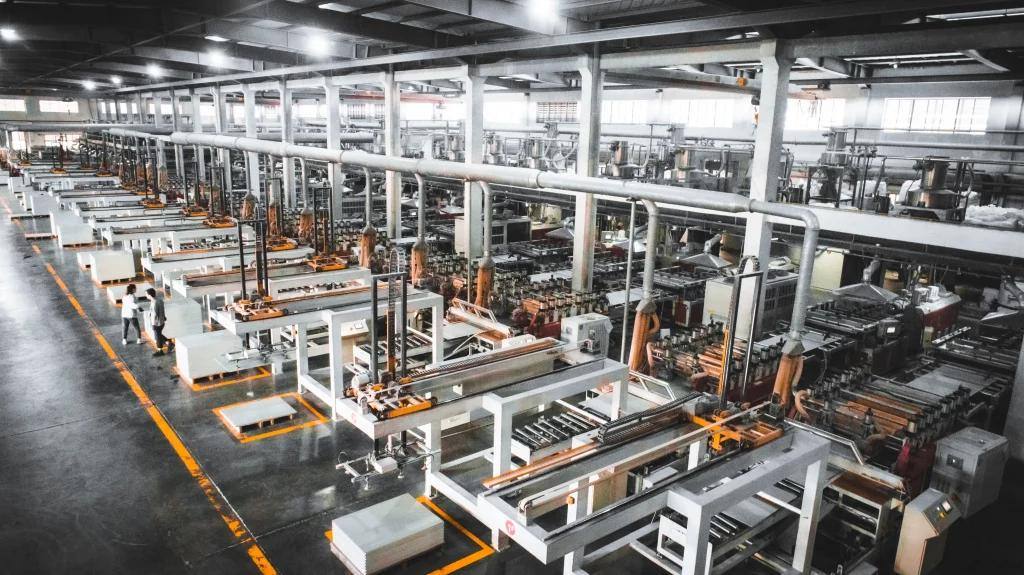
In the plastic flooring manufacturing industry, selecting the right extrusion tooling configuration directly impacts product quality, daily operational efficiency, and raw material utilization. Stone Plastic Composite (SPC) flooring production demands precise dimensional accuracy across board widths of 1050 mm to 1350 mm and thickness ranges spanning 3 mm to 9 mm. Positioned at the core of the extrusion line, the T-die must process high-density polymer melts under high pressure to ensure uniform core layer formation.
As a pioneer in SPC flooring equipment, Boyu brings over 22 years of continuous technical innovation to the global extrusion sector. Operating from a 30,000-square-meter production facility commissioned in 2019, the company holds ISO-9001 certification and maintains an experienced R&D team featuring over ten senior engineers. The company holds more than 60 accumulated technical patents and software copyrights across international markets.
When upgrading rigid core extrusion lines, plant managers face a critical tooling decision: manual versus auto-adjusting T-dies. This comparison evaluates both die technologies available across Boyu machinery lines to help manufacturers select the optimal configuration for their operational goals.
The Technical Role of Extrusion Dies in SPC Flooring Production
Extrusion T-dies serve as the shaping interface where molten compound transitions from the twin-screw extruder to downstream four-roll calendering systems. In standard SPC formulations, PVC resin is mixed with high ratios of calcium carbonate (typically structured at a 1:3 ratio) along with specialized stabilizers. This high filler concentration creates abrasive melt conditions and complex flow dynamics.
To prevent board defects such as cross-web gauge variation, internal stress, edge waving, or surface imperfections, the extrusion die must maintain uniform melt velocity, precise thermal control, and balanced pressure across the entire profile width. Proper tooling configuration directly influences line commissioning times, raw material scrap generation, labor allocation, and energy performance.
Manual Adjusting Dies in Extrusion Lines
Boyu‘s manual T-dies utilize flexible lip mechanisms controlled by high-tensile differential adjustment bolts positioned along the die lip. Technicians perform fine-tuning using precision feeler gauges and calibrated torque tools during setup and routine operational monitoring.
Key operational advantages include:
Capital Cost Efficiency: Manual dies require lower initial capital expenditure, making them a practical choice for new facilities, standard volume lines, or regional manufacturing plants.
Robust Mechanical Design: Constructed without sensitive electronic sensors embedded in the heated die block, manual dies offer strong mechanical durability, thermal stress resistance, and straightforward maintenance.
Flexible Technical Fine-Tuning: Experienced extrusion engineers can manually adjust lip openings to accommodate custom resin formulations, variations in recycled material ratios, or specialized melt flow rates.
However, manual calibration requires hands-on adjustments near elevated operating temperatures. Achieving precise thickness tolerances during cold startups or product changeovers requires longer calibration cycles, generating higher startup scrap before reaching steady-state production.
Auto-Adjusting Dies in Boyu Machinery Lines
Auto-adjusting T-dies feature closed-loop thickness control systems powered by thermal expansion bolts or electric servo actuators. Integrated with non-contact online thickness measuring gauges, the system automatically calculates deviation maps and sends rapid micro-adjustments to the die lip in real time.
Key performance benefits include:
High-Precision Closed-Loop Automation: Connected to intelligent PLC control platforms featuring Siemens or Omron components, auto-adjusting dies continuously maintain rigid core board thickness tolerances within tight margins without manual labor.
Scrap Reduction and Faster Commissioning: Rapid thermal response times substantially shorten warmup calibration cycles, reducing raw material scrap during startup and maximizing material yield.
Lower Operating Costs and Energy Savings: Automated adjustment minimizes operator dependence, lowers labor intensity, and optimizes thermal energy distribution across the die body.
Seamless Integration with High-Capacity Extruders: For high-capacity twin-screw extruders, auto-adjusting dies ensure uniform board density and steady melt distribution at linear production speeds reaching 5 to 9 meters per minute.
Technical Comparison Matrix
| Performance Indicator | Manual Adjusting Die | Auto-Adjusting Die (PLC Integrated) |
| Capital Investment | Economical upfront cost | Higher initial machinery investment |
| Adjustment Mechanism | Manual push-pull bolt tuning | Closed-loop thermal/servo actuator |
| Gauge Precision | Operator dependent | Micro-meter closed-loop |
| Startup Scrap Material | Moderate to higher during warmup | Minimal due to rapid automatic tuning |
| Labor Requirement | Reliance on skilled technicians | Automated with minimal operator intervention |
| Target Plant Profile | Flexible runs, lower capital budgets | Continuous high-output, multi-shift plants |
Strategic Die Selection for Maximum Yield
For SPC flooring plants operating high-volume, multi-shift production schedules where material yield and maximum throughput dictate profitability, auto-adjusting T-dies deliver substantial operational advantages and a rapid return on investment. Conversely, facilities prioritizing lower capital investment or running specialized, short production runs can rely on manual T-dies as a durable, proven technology.
As a full-service machinery provider, the company supplies turnkey plastic flooring manufacturing solutions—including conical twin-screw extruders, T-dies, four-roll calenders, water cooling temperature control units, traction units, shearing cutters, and automatic stacking systems. Equipment is certified under CE and ISO-9001 standards, serving industrial partners across North America, Europe, the Middle East, Africa, and Asia, such as the United States, Poland, Turkey, Vietnam, India, and beyond.
Backed by 22 years of industry leadership and more than 60 technical patents, Boyu can tailor custom extrusion systems to match your exact technical requirements.
